
Introduction
Digital marketing has transformed the way businesses connect with customers. Whether you own a startup, manage a growing enterprise, or run an established organization, reaching the right audience at the right time has become essential for sustainable growth.
While search engine optimization (SEO), paid advertising, content marketing, and social media continue to play significant roles in online marketing, two channels consistently outperform many others when it comes to customer engagement and return on investment (ROI): Email Marketing and SMS Marketing.
Unlike social media platforms that rely on constantly changing algorithms, email and SMS provide direct communication with your audience. When customers subscribe to your emails or opt in to receive text messages, your business gains a reliable communication channel that can be used to build relationships, promote products, share updates, and increase sales.
However, successful digital marketing is more than simply sending messages. It starts with building a high-quality contact database, organizing customer information, creating valuable content, automating campaigns, and measuring performance. Businesses that combine these practices with professional marketing software can significantly improve efficiency while delivering a better customer experience.
In this comprehensive guide, you’ll learn how digital marketing works, why email and SMS remain powerful marketing channels, how to build quality mailing lists, and how specialized software such as Bulk Email Sender, Android Bulk SMS Sender, and Email Extractor tools can simplify your marketing workflow and help you achieve long-term business growth.
Table of Contents
- What is Digital Marketing?
- Why Email & SMS Marketing Continue to Deliver Exceptional ROI
- Understanding the Modern Digital Marketing Funnel
- Email Marketing: The Foundation of Customer Communication
- Building a High-Quality Email Database
- Bulk Email Sender Software
- Creating High-Converting Email Campaigns
- Email Marketing Best Practices
- Marketing Automation Fundamentals
What is Digital Marketing?
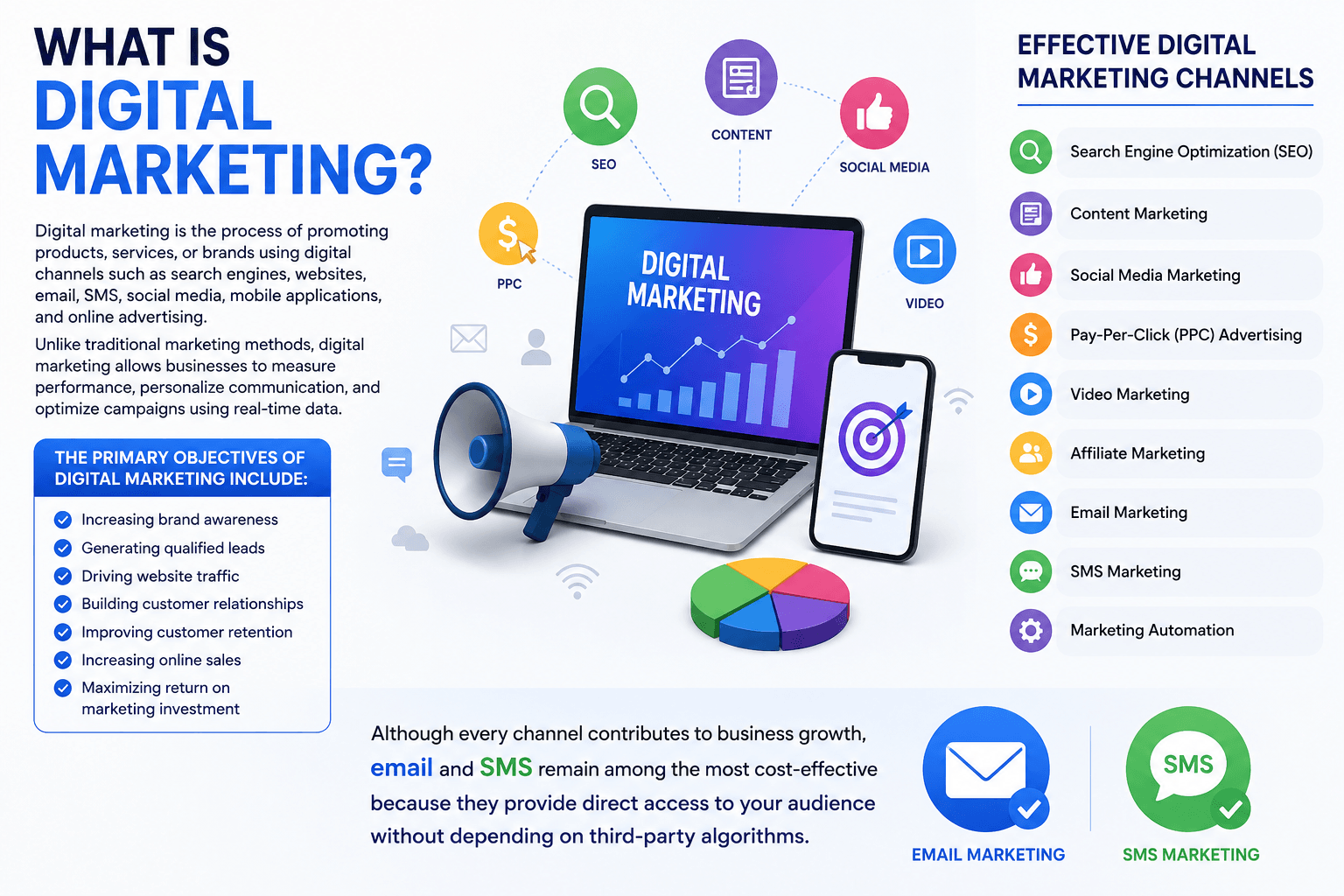
Digital marketing is the process of promoting products, services, or brands using digital channels such as search engines, websites, email, SMS, social media, mobile applications, and online advertising.
Unlike traditional marketing methods, digital marketing allows businesses to measure performance, personalize communication, and optimize campaigns using real-time data.
The primary objectives of digital marketing include:
- Increasing brand awareness
- Generating qualified leads
- Driving website traffic
- Building customer relationships
- Improving customer retention
- Increasing online sales
- Maximizing return on marketing investment
A successful digital marketing strategy combines multiple channels that work together throughout the customer journey.
Some of the most effective digital marketing channels include:
- Search Engine Optimization (SEO)
- Content Marketing
- Social Media Marketing
- Pay-Per-Click (PPC) Advertising
- Video Marketing
- Affiliate Marketing
- Email Marketing
- SMS Marketing
- Marketing Automation
Although every channel contributes to business growth, email and SMS remain among the most cost-effective because they provide direct access to your audience without depending on third-party algorithms.
Why Email & SMS Marketing Continue to Deliver Exceptional ROI
Many marketers ask whether email marketing is still relevant in an era dominated by social media and messaging apps. The answer is a resounding yes.
Email and SMS remain highly effective because they enable businesses to communicate directly with customers who have already expressed interest in their products or services.
Advantages of Email Marketing
Email marketing allows businesses to:
- Share detailed product information
- Send newsletters
- Announce new product launches
- Promote seasonal offers
- Educate potential customers
- Nurture leads
- Build long-term customer relationships
- Recover abandoned shopping carts
- Encourage repeat purchases
Unlike social media posts that may disappear from users’ feeds within hours, emails remain in the inbox until recipients choose to read, archive, or delete them.
Advantages of SMS Marketing
SMS marketing complements email by providing instant communication.
Businesses use SMS for:
- Flash sale announcements
- Appointment reminders
- Payment notifications
- Delivery updates
- OTP verification
- Event reminders
- Customer feedback requests
- Limited-time promotions
Because text messages are typically read within minutes of delivery, SMS is ideal for time-sensitive communication.
The combination of email and SMS allows businesses to educate customers through detailed emails while reinforcing important messages with concise SMS reminders.
Understanding the Modern Digital Marketing Funnel
Every customer follows a journey before making a purchase. Understanding this process helps businesses send the right message at the right time.
Stage 1: Awareness
Potential customers discover your business through:
- Google Search
- Blog articles
- Social media
- Online advertisements
- Referrals
At this stage, educational content is more valuable than promotional messaging.
Stage 2: Interest
Visitors begin exploring your website and learning about your products.
They may:
- Read blogs
- Download guides
- Subscribe to newsletters
- Request demonstrations
This is where lead generation begins.
Stage 3: Consideration
Potential customers compare different solutions.
Businesses should provide:
- Product comparisons
- Customer testimonials
- Case studies
- Product demonstrations
- Email follow-up campaigns
Stage 4: Conversion
The prospect becomes a customer.
This is the ideal time for:
- Welcome emails
- Thank-you messages
- Purchase confirmations
- Product tutorials
Stage 5: Retention
The relationship doesn’t end after the sale.
Businesses should continue engaging customers through:
- Newsletters
- Product updates
- Loyalty programs
- Renewal reminders
- Customer surveys
Long-term customer retention often costs less than acquiring new customers.
Email Marketing: The Foundation of Customer Communication
Email marketing remains one of the most effective digital marketing channels because it allows businesses to communicate directly with customers in a professional, measurable, and highly personalized way.
Whether you’re promoting a new product, sharing educational content, announcing special offers, or nurturing potential customers, email provides the flexibility to deliver detailed information that other channels cannot.
Some of the most common types of email campaigns include:
- Welcome emails
- Monthly newsletters
- Promotional campaigns
- Product launch announcements
- Educational content
- Event invitations
- Customer feedback requests
- Renewal reminders
- Abandoned cart recovery
- Re-engagement campaigns
When combined with customer segmentation and personalization, email marketing can significantly improve open rates, click-through rates, and conversions.
Building a High-Quality Email Database
The success of any email marketing campaign depends on the quality of your contact database.
Rather than purchasing email lists—which often result in poor engagement and higher spam complaints—businesses should focus on building permission-based mailing lists.
Effective ways to grow your email list include:
- Newsletter subscription forms
- Downloadable eBooks and guides
- Product demo requests
- Webinar registrations
- Contact forms
- Customer registrations
- Event sign-ups
- Loyalty programs
As your database grows, regularly clean and organize it by removing duplicate or inactive contacts and segmenting subscribers based on their interests, location, or purchase history.
A clean, well-maintained list improves deliverability and ensures that your campaigns reach the right audience.
Bulk Email Sender Software: Simplifying Large-Scale Email Campaigns
As your subscriber list grows, manually sending emails becomes impractical. Professional Bulk Email Sender Software enables businesses to create, schedule, personalize, and deliver campaigns efficiently.
For businesses looking for a reliable solution, Bulk Email Sender can help streamline email communication:
Bulk Email Sender: https://www.lantechsoft.com/bulk-mailer.html
Key Features
- Send bulk emails to thousands of recipients
- SMTP server integration
- HTML and plain-text email support
- Personalized email merging
- Campaign scheduling
- Contact management
- Email list segmentation
- Attachment support
- Bounce handling
- Delivery reporting
- Campaign analytics
- Automated follow-up sequences
Business Benefits
Using professional email software helps businesses:
- Save valuable time
- Reach a larger audience
- Improve campaign consistency
- Personalize communication
- Increase customer engagement
- Track campaign performance
- Enhance marketing ROI
Whether you’re running a small business or managing enterprise-level campaigns, dedicated email marketing software makes communication more efficient and scalable.
Creating High-Converting Email Campaigns
Sending emails is easy; creating campaigns that drive engagement and conversions requires planning.
A successful email campaign typically includes:
A Strong Subject Line
Your subject line determines whether recipients open your email.
Examples:
- Save 40% This Weekend Only
- New Product Launch: Be the First to Explore
- Your Exclusive Member Benefits Are Here
- Limited-Time Offer Ends Tonight
Personalized Content
Address recipients by name and tailor content based on their interests, previous purchases, or browsing behavior.
Personalized emails often generate higher engagement than generic messages.
Clear Call-to-Action (CTA)
Every email should encourage readers to take a specific action, such as:
- Shop Now
- Download the Guide
- Book a Demo
- Contact Our Team
- Claim Your Discount
Mobile-Friendly Design
Most emails are opened on smartphones, so ensure that:
- Text is easy to read
- Images are optimized
- Buttons are large enough to tap
- Layouts adapt to different screen sizes
Email Marketing Best Practices
To maximize campaign performance:
- Build permission-based mailing lists.
- Segment audiences for relevant messaging.
- Personalize subject lines and content.
- Test different email designs and CTAs.
- Avoid excessive promotional content.
- Maintain a consistent sending schedule.
- Monitor open rates, click-through rates, and conversions.
- Remove inactive subscribers regularly.
- Comply with email marketing regulations and provide a clear unsubscribe option.
Following these practices helps improve sender reputation and long-term engagement.
Marketing Automation: Working Smarter, Not Harder
Marketing automation enables businesses to send the right message at the right time without manual intervention.
Instead of creating every email individually, automated workflows respond to customer actions such as subscribing to a newsletter, making a purchase, or requesting information.
Common automated email sequences include:
- Welcome series
- Lead nurturing campaigns
- Product recommendations
- Birthday greetings
- Purchase confirmations
- Renewal reminders
- Customer feedback requests
- Re-engagement campaigns
Automation saves time, improves consistency, and ensures customers receive relevant communication throughout their journey.
SMS Marketing, Lead Generation, Email Extractors, AI & CRM Integration
In Part 1, we explored the fundamentals of digital marketing, the importance of email marketing, building a quality mailing list, using Bulk Email Sender software, and creating high-converting email campaigns.
Now it’s time to complete the second pillar of modern digital marketing—SMS Marketing—and discover how businesses can build targeted prospect databases using Email Extractor software while leveraging AI and CRM integration to automate their marketing efforts.
SMS Marketing: The Fastest Way to Reach Your Customers
While email marketing is ideal for detailed communication, SMS marketing excels when businesses need immediate attention from customers.
Almost everyone carries a smartphone, and text messages are typically read within minutes of delivery. This makes SMS one of the most powerful communication channels available for businesses.
Unlike social media, where posts compete with thousands of other updates, SMS messages arrive directly in the recipient’s messaging inbox.
For businesses looking to increase customer engagement, improve response rates, and deliver urgent information, SMS marketing has become an essential component of a successful digital marketing strategy.
What is SMS Marketing?
SMS (Short Message Service) Marketing is the practice of sending promotional, informational, or transactional text messages directly to customers’ mobile phones.
Businesses use SMS marketing to communicate with customers who have opted in to receive messages.
Typical SMS campaigns include:
- Promotional offers
- Flash sales
- Festival greetings
- Appointment reminders
- Payment reminders
- Delivery notifications
- Event invitations
- Customer surveys
- Product launch announcements
- Loyalty rewards
SMS marketing is particularly effective because it delivers concise, actionable messages that encourage immediate customer responses.
Why Businesses Should Invest in SMS Marketing
SMS marketing offers several advantages over many other digital channels.
1. Instant Delivery
Messages are delivered within seconds, making SMS ideal for time-sensitive campaigns.
Whether you’re announcing a flash sale or reminding customers about an appointment, SMS ensures your message arrives quickly.
2. Exceptional Open Rates
Text messages are among the most frequently viewed forms of digital communication.
Customers often read SMS notifications almost immediately, making this channel highly effective for urgent updates and promotional offers.
3. Higher Customer Engagement
Because SMS messages are short and direct, customers are more likely to read and respond.
Businesses commonly use SMS for:
- Coupon codes
- Discount announcements
- Limited-time offers
- Product availability alerts
- Customer support updates
4. Cost-Effective Marketing
Compared with many traditional advertising methods, SMS campaigns provide excellent value, especially for businesses targeting existing customers.
5. Better Customer Retention
Regular communication through SMS helps businesses remain connected with customers between purchases.
Simple reminders and personalized offers encourage repeat business and strengthen customer loyalty.
Android Bulk SMS Sender Software
Managing large SMS campaigns manually can be time-consuming and inefficient.
Professional Android Bulk SMS Sender Software allows businesses to send personalized messages to thousands of recipients quickly while organizing contacts and tracking campaign performance.
Learn more here:
Android Bulk SMS Sender
https://www.lantechsoft.com/android-bulk-sms-sender.html
Key Features
Professional SMS software typically includes:
- Bulk SMS sending
- Android phone integration
- Multi-device support
- Contact management
- Personalized SMS
- Unicode language support
- Excel and CSV import
- Duplicate removal
- Scheduled campaigns
- Campaign history
- Delivery reports
- Group messaging
Best Practices for SMS Campaigns
To maximize customer engagement:
Keep Messages Short
Customers prefer concise messages that communicate value quickly.
Example:
Summer Sale! Get 40% OFF today. Use code SAVE40. Shop Now.
Personalize Messages
Including the customer’s name or referencing previous purchases can significantly improve engagement.
Include a Clear Call-to-Action
Every SMS should encourage recipients to take the next step.
Examples:
- Shop Now
- Book Today
- Claim Offer
- Register Now
- Download App
Respect Customer Preferences
Only send SMS messages to customers who have opted in and provide a simple way to stop receiving promotional messages where required.
Combining Email and SMS Marketing
The highest-performing marketing campaigns use both channels together.
Each channel serves a different purpose.
| Email Marketing | SMS Marketing |
|---|---|
| Detailed information | Quick reminders |
| Product launches | Flash sales |
| Newsletters | OTPs |
| Educational content | Appointment reminders |
| Promotions | Delivery alerts |
| Customer nurturing | Urgent notifications |
Example Campaign:
Day 1
Send an email introducing a new product.
Day 2
Send an SMS reminding customers about the launch.
Day 4
Email customer testimonials.
Day 6
Final SMS:
“Offer Ends Tonight!”
This coordinated approach increases visibility and encourages conversions.
Lead Generation: The Foundation of Successful Marketing
Before businesses can send emails or SMS messages, they need a high-quality contact database.
Lead generation is the process of identifying potential customers who may be interested in your products or services.
Strong lead generation improves campaign effectiveness and helps marketing teams focus on relevant prospects.
Building Better Prospect Lists
Businesses can build contact databases through:
- Website forms
- Newsletter subscriptions
- Customer registrations
- Trade shows
- Webinars
- Online directories
- Existing customer databases
- Publicly available business information
As your database grows, organizing and maintaining accurate contact information becomes increasingly important.
This is where Email Extractor software becomes valuable.
Web Email Extractor
Finding business contact information manually can require hours of research.
A Web Email Extractor automates the process by scanning websites and collecting publicly available email addresses.
Learn more:
Web Email Extractor
https://www.lantechsoft.com/web-email-extractor.html
Common Applications
Businesses use Web Email Extractor software for:
- B2B lead generation
- Market research
- Business directory collection
- Prospect identification
- Sales outreach preparation
Typical Features
- Website scanning
- Multi-threaded extraction
- Keyword search
- Domain filtering
- Duplicate removal
- Export to Excel
- Export to CSV
- Export to TXT
Using a Web Email Extractor responsibly can save countless hours of manual research and improve lead generation efficiency.
Outlook Email Extractor
Many organizations store years of valuable customer communication inside Microsoft Outlook.
When businesses need to organize or migrate contact information, manually copying addresses becomes impractical.
An Outlook Email Extractor simplifies this process.
Learn more:
Outlook Email Extractor
https://www.lantechsoft.com/email-outlook-n-express-42.html
Benefits
Businesses commonly use Outlook Email Extractor software to:
- Export contacts
- Organize customer databases
- Migrate email addresses
- Consolidate mailing lists
- Recover historical contact information
- Improve marketing databases
This helps organizations preserve valuable customer relationships while reducing administrative work.
Files Email Extractor
Important customer information often exists inside documents rather than email systems.
Businesses may have thousands of email addresses stored in:
- Word documents
- Excel spreadsheets
- PDF files
- PowerPoint presentations
- Text files
- CSV files
Instead of searching each document manually, a Files Email Extractor can automatically locate and organize email addresses.
Learn more:
Files Email Extractor
https://www.lantechsoft.com/email-extractor-file.html
Advantages
- Save research time
- Organize business contacts
- Consolidate existing databases
- Support marketing campaigns
- Reduce manual work
Responsible Lead Generation
Quality matters more than quantity.
Businesses should always:
- Build permission-based marketing lists where required.
- Respect applicable privacy regulations.
- Remove duplicate and invalid contacts.
- Keep databases up to date.
- Send relevant, valuable communications.
Responsible marketing helps build trust and improves long-term campaign performance.
AI is Transforming Digital Marketing
Artificial Intelligence has changed how businesses manage email and SMS campaigns.
Modern marketing platforms can now:
- Predict customer behavior
- Recommend products
- Optimize send times
- Personalize messages
- Segment audiences automatically
- Generate email subject lines
- Analyze campaign performance
- Score leads based on engagement
AI helps businesses deliver more relevant communication while reducing manual effort.
CRM Integration
Customer Relationship Management (CRM) systems store valuable customer information that can improve marketing performance.
Integrating CRM with email and SMS software allows businesses to:
- Track customer interactions
- Create personalized campaigns
- Automate follow-ups
- Score leads
- Monitor sales opportunities
- Improve customer service
Instead of maintaining separate databases, CRM integration creates a unified view of every customer.
Marketing Workflow, ROI, Best Practices, FAQs, SEO Assets & Conclusion
In Part 1, we explored digital marketing fundamentals, email marketing, and Bulk Email Sender software. In Part 2, we covered SMS marketing, lead generation, Email Extractor tools, AI, and CRM integration.
This final section focuses on turning these strategies into a repeatable marketing system that helps businesses attract leads, nurture prospects, convert customers, and retain them for long-term success.
Building a Complete Digital Marketing Workflow
Successful digital marketing isn’t about sending random emails or SMS messages. It’s about creating a structured process that guides prospects from their first interaction with your business to becoming loyal customers.
A proven workflow looks like this:
Step 1: Define Your Target Audience
Before launching any campaign, identify:
- Industry
- Business size
- Geographic location
- Customer needs
- Buying behavior
- Budget
- Decision makers
Knowing your audience helps create more relevant campaigns.
Step 2: Build Your Contact Database
A marketing campaign is only as effective as the quality of its contact list.
Businesses can build databases through:
- Website forms
- Customer registrations
- Newsletter subscriptions
- Trade shows
- Existing customer records
- Referral programs
- Publicly available business information
Where appropriate and compliant with applicable laws, businesses can also organize existing contacts using:
Bulk Email Sender
https://www.lantechsoft.com/bulk-mailer.html
Web Email Extractor
https://www.lantechsoft.com/web-email-extractor.html
Outlook Email Extractor
https://www.lantechsoft.com/email-outlook-n-express-42.html
Files Email Extractor
https://www.lantechsoft.com/email-extractor-file.html
Always ensure your marketing practices comply with local privacy and anti-spam regulations and that you have the appropriate permission where required.
Step 3: Organize and Segment Your Contacts
Not every customer should receive the same message.
Segment contacts based on:
- Industry
- Location
- Customer type
- Previous purchases
- Website activity
- Engagement level
- Interests
- Language
Segmentation enables highly targeted campaigns that improve open rates and conversions.
Step 4: Create Valuable Content
People don’t subscribe just to receive advertisements.
Successful businesses send content that educates, informs, and solves problems.
Examples include:
Email Content
- Industry news
- Product launches
- Tutorials
- Customer success stories
- Newsletters
- Buying guides
- Special offers
SMS Content
- Flash sales
- Appointment reminders
- Delivery notifications
- Festival greetings
- Payment reminders
- Limited-time discounts
The key is balancing promotional and educational content.
Step 5: Launch Multi-Channel Campaigns
Instead of relying on one marketing channel, combine several.
Example campaign:
Day 1
Publish a blog article.
Share it on social media.
Send an email newsletter.
Day 2
Send an SMS reminder.
Day 4
Email customer testimonials.
Day 6
Final SMS:
“Offer Ends Tonight!”
Using multiple channels increases visibility and engagement without overwhelming customers.
Step 6: Track Campaign Performance
Successful marketers measure everything.
Important Email KPIs include:
- Delivery Rate
- Open Rate
- Click-Through Rate (CTR)
- Bounce Rate
- Conversion Rate
- Unsubscribe Rate
- Revenue per Campaign
Important SMS KPIs include:
- Delivery Rate
- Open Rate
- Link Clicks
- Responses
- Conversions
- Opt-Out Rate
Monitoring these metrics helps identify what works and where campaigns can be improved.
Marketing Automation: Scaling Your Business
Automation allows businesses to communicate consistently without manually sending every message.
Examples of automated workflows include:
Welcome Series
Immediately after someone subscribes:
- Welcome Email
- Company Introduction
- Product Overview
- Discount Coupon
Lead Nurturing
If a visitor downloads a guide:
Day 1
Thank-you email.
Day 3
Educational article.
Day 6
Case study.
Day 10
Product demonstration invitation.
Cart Recovery
For e-commerce businesses:
- Reminder email
- SMS reminder
- Discount offer
- Final follow-up
Customer Retention
After purchase:
- Thank-you email
- Product tips
- Feedback request
- Cross-sell recommendations
- Renewal reminders
Automation keeps customers engaged throughout the entire lifecycle.
Industry Use Cases
Retail & E-commerce
Retailers use email and SMS for:
- New arrivals
- Seasonal promotions
- Discount campaigns
- Loyalty rewards
- Order confirmations
Healthcare
Healthcare providers use:
- Appointment reminders
- Prescription refill alerts
- Health awareness campaigns
- Patient feedback requests
Education
Educational institutions benefit from:
- Admission announcements
- Course reminders
- Student updates
- Event invitations
Real Estate
Real estate professionals use email and SMS for:
- Property launches
- Investment opportunities
- Site visit confirmations
- Market updates
Hospitality
Hotels and travel companies send:
- Booking confirmations
- Check-in reminders
- Promotional packages
- Customer feedback requests
Software Companies
Technology companies use email marketing to:
- Launch products
- Deliver newsletters
- Share software updates
- Announce webinars
- Generate trial sign-ups
SMS is ideal for:
- Renewal reminders
- Security alerts
- Maintenance notifications
- Limited-time offers
Common Digital Marketing Mistakes
Avoid these common mistakes:
❌ Buying email lists
❌ Sending generic messages to everyone
❌ Ignoring customer segmentation
❌ Poor subject lines
❌ Too many promotional emails
❌ No clear call-to-action
❌ Ignoring analytics
❌ Failing to optimize for mobile devices
❌ Not cleaning contact databases
❌ Inconsistent communication
Correcting these issues can dramatically improve campaign performance.
The Future of Email & SMS Marketing
Digital marketing continues to evolve with new technologies.
Key trends include:
- AI-generated content
- Predictive customer analytics
- Hyper-personalization
- Intelligent audience segmentation
- Automated customer journeys
- Omnichannel marketing
- Interactive emails
- Rich Communication Services (RCS)
- Voice search integration
- Advanced campaign analytics
Businesses that adopt these innovations early will be better positioned to build lasting customer relationships.
Frequently Asked Questions (FAQs)
1. Is email marketing still effective?
Yes. Email marketing remains one of the highest ROI digital marketing channels when used with personalization, segmentation, and automation.
2. Why should businesses combine email and SMS marketing?
Email is ideal for detailed communication, while SMS is excellent for urgent notifications and reminders. Using both creates a stronger customer experience.
3. What is Bulk Email Sender software used for?
Bulk Email Sender software helps businesses send personalized email campaigns, newsletters, promotional offers, and automated messages to large contact lists efficiently.
Learn more:
https://www.lantechsoft.com/bulk-mailer.html
4. What is Android Bulk SMS Sender software?
Android Bulk SMS Sender software enables businesses to send promotional SMS messages, reminders, alerts, and notifications to multiple recipients using Android devices.
https://www.lantechsoft.com/android-bulk-sms-sender.html
5. What is a Web Email Extractor?
It helps collect publicly available email addresses from websites and online directories, making business research and contact organization more efficient.
https://www.lantechsoft.com/web-email-extractor.html
6. What is Outlook Email Extractor?
It extracts email addresses and contacts from Outlook data files, helping businesses organize and migrate customer information.
https://www.lantechsoft.com/email-outlook-n-express-42.html
7. What is Files Email Extractor?
Files Email Extractor locates email addresses stored in Word, Excel, PDF, PowerPoint, and text documents, allowing businesses to consolidate existing contact information.
https://www.lantechsoft.com/email-extractor-file.html
8. What industries benefit from email marketing?
Retail, healthcare, education, real estate, hospitality, finance, manufacturing, software companies, and professional services.
9. How often should businesses send marketing emails?
Consistency is more important than frequency. Many businesses find success with one to four emails per month, depending on audience expectations and content quality.
10. Can small businesses use email and SMS marketing?
Absolutely. Email and SMS marketing are affordable, scalable, and suitable for businesses of all sizes.
Final Thoughts
Digital marketing has become an essential part of business growth, but success depends on using the right channels, tools, and strategies.
Email Marketing helps businesses educate, nurture, and convert prospects through personalized communication. SMS Marketing delivers instant engagement for time-sensitive updates and promotions. Together, they create a powerful multichannel approach that strengthens customer relationships and drives higher conversions.
Professional tools such as Bulk Email Sender, Android Bulk SMS Sender, Web Email Extractor, Outlook Email Extractor, and Files Email Extractor can simplify campaign management, organize valuable contact data, and improve marketing efficiency. When combined with automation, analytics, and responsible data management, these tools help businesses save time while delivering more relevant customer experiences.
The future of digital marketing belongs to organizations that focus on personalization, automation, compliance, and delivering genuine value to their audiences. By adopting these best practices and continuously measuring campaign performance, businesses can build stronger brands, generate more qualified leads, and achieve sustainable long-term growth.
